Archive

Archive for the ‘Fixed Interest’ Category

Australian Government Bond Yields…continue slight improvement

January 29, 2012 Leave a comment

Source: RBA

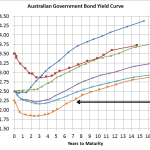
Its been a few weeks since I provided an update on the local government yield curve and consistent with the slight improvement in the sharemarket the Australian Government Bond Yield Curve has indicated a better outlook for the local economy. As the chart shows, since 6 January the yield curve has increased around 20bps across all maturities which isn’t a bad increase but yields still aren’t as high as they were last November.

Current figures still suggest the Reserve Bank will decrease its cash rate next meeting and the shape of the curve is consistent with weaker economic outlook suggested by the IMF and World Bank reports. It also suggests that inflation continues to be a non-threat and the ABS inflation figures showed that the market was pretty much correct by dismissing inflation over recent months.

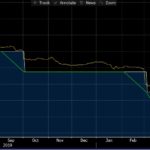
Since October the S&P500 has rallied around 20% in the face of some pretty ugly political behaviour in both the US and Europe regarding their respective economies and that’s quite a surprise. This is also supported by the downtrend in the VIX…see below chart…given the current downside risks I tend to think this trend will reverse and volatlility will increase.

Source: Bloomberg

I don’t know what direction equity markets will go but my thoughts are to stay conservative…there’s a lot of water to pass under the economic bridge before catastrophic risks (global/European banking meltdown) is off the table. Whilst the market’s suggesting the risk is reducing its still there.

PDF    Send article as PDF   

Bond ETFs on the ASX…now the game begins

January 15, 2012 Leave a comment

With the ASX last week announcing that it is allowing bond ETFs to trade on the market, financial planners have the last basic building block in place to recommend portfolios that are completely listed covering all major asset classes. Previously listed portfolios were limited to equities (local and global of varying strategies) and commodities. With the inclusion of bond ETFs on the ASX that may result in many financial advisers abandoning master trust and wrap platforms, whereby they used managed funds for their fixed interest exposure, to the more transparent and lower cost listed portfolios.

With the movement to fee-for-service by the financial planning industry, thanks to the Future of Financial Advice (FOFA) reforms that kick off in July, ETFs are bound to be a very popular investment vehicle by financial planners so we will undoubtedly see further cost cutting by the platforms and further consolidation as the smaller platforms struggle to stay profitable.

This change of rules by the ASX is way overdue and whilst this initial move into bond ETFs is a small step…underlying bonds must come from only two Australian bond indices (UBS Composite or S&P Australian Fixed Interest)…its bound to start a significant change in behaviour in the financial planning and investment platform industries.

Free PDF    Send article as PDF   

The change in outlook for the 2011 Australian Economy in one picture

January 10, 2012 Leave a comment

Source: RBA

The above chart shows pretty much what happened to the outlook for the Austrlaian economy and why bonds were the best investment for the year.

It shows the longer terms yields (3 years and above) dropping by up to 200bps thus providing very large capital gains for bond investors who had the courage of buying long term bonds at the start of the year. This yield curve movement also indicated the declining outlook for the Australian economy thanks largely to the Euro crisis and its potential impact on the banking system across the world.

For the short term bond holders (terms of 1 to 3 years), yields dropped by up to 150bps still providing strong capital growth. Whilst the yield to maturity dropped enormously across all maturies for Australian Government bonds, the Reserve Bank took a while to start the decrease and then only decreased by 50bps by the end of December. This curve still suggests the RBA has a few rate decreases to come and the Euro crisis will probably be the main determinant of that. That is despite the weak retail sales and weak residential property sales that provide increasing evidence of our weaker than you know economy. The Reserve Bank are also forecasting lower commodity prices which doesn help our resources sector so the outlook for growth across our economy may be moving closer to a one speed economy than we think.

Anyway, the year 2011 was certainly a year where the conservative bond investor was a winner and whilst I haven’t seen the final numbers yet, it looks like the gross returns should be a comfortably in double digits.

PDF Printer    Send article as PDF   

Corporate Credit…maybe

December 25, 2011 Leave a comment

Source: RBA

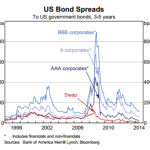
Despite the above chart being a few weeks old, the above chart shows credit spreads have widened significantly over the past few months such that at the end of November, both A and BBB rated corporates have spreads in excess of 300bps. When you consider that the historic default risk is much much lower than these spreads I do believe accepting this type of risk in a well diversified portfolio (that is, with a fund) is an investment that could provide good returns over the next few years. The biggest issues with this type of portfolio relates to liquidity and the ongoing volatility.

Liquidity, or the potential lack of, is why the spreads are as wide as they are. So holding credit investment for as long as possible or through to maturity is recommended. Volatility risk is expected to be quite high as the correlation will be strong with equities. So whilst there is potential for short term falls in value for corporate credit, as long as defaults don’t hit very high and significant record levels, this type of investment should provide a decent return over the next few years. So now that I’ve written it, I guess finding a relatively passive credit fund is the next challenge.

The last thing I want to say regarding corporate credit spreads that are reflected in the above chart is the fact that there is probably a high proportion of banking and other financial services debt included in there. Because it is Australian and our financial institutions appear to be much much stronger than our international counterparts, at this stage I’m not particularly concerned…but it is the financial institutions that will create the volatility in this index thanks to the European situation and the difficulty in raising overseas capital.

PDF Creator    Send article as PDF   

Australian Government Bond Yields…there’s now a 2 there

December 19, 2011 Leave a comment

Source: Bloomberg & RBA

Thought I’d check the Australian Government Bond yield curve to see if the market is confirming my bearish sentiment on the Australian economy and it looks like it is. 3 Year bond yields have dropped below 3%…that’s an ugly indicator for our economy.

PDF Printer    Send article as PDF   

Australian Government Bond Yield Curve…no change in 2 weeks

December 7, 2011 Leave a comment

Source: RBA

As the above chart shows the yield curve dropped significantly from the start of August through to towards the end of November and at the end of yesterday after the RBA dropped the cash rate another 25bps to 4.25%, the yield curve is basically the same as it was two weeks ago.

Whilst Australian equity markets have had a decent couple of weeks (the ASX200 was below 4000 on the 25th Nov) the same can’t be said for government bonds. Either way, its still about Europe and with so many uncertainties ongoing sharemarket volatility is bound to continue. I must say, that whilst 3 and 4 year bonds are just above 3%, you can still find term deposits around 6% which is a very attractive margin. Financial institutions are clearly prepared to pay a premium for capital so I’d be surprised if too many pass on the RBA rate cut to us mortgage owners!

PDF Creator    Send article as PDF   

Australian Government Bond Yields…seriously low

November 24, 2011 Leave a comment

Source: RBA

Just when you think the yield curve can’t get any lower, the last 8 days have taken another 10 to 15bps off. Sharemarkets have obviously dropped on the Euro-debacle and this yield curve demonstrates not only significant interest rate reductions in the months to come but a significantly slowing Australian eonomy thanks to the global pressures.

Futures markets are banking on 25bps drop in the RBA next month and another 50bps in February 2012. This doesn’t mean the yield curve will drop but either way, I am still happy to lock in my home loan for the next few years at a rate that is significantly below variable rates, but that’s enough about me.

Investment strategy-wise, loads of uncertainty is the norm and term deposits continue to pay a massive spread over government bonds. Our sharemarket carries a bit of risk amongst banks and resources so I’m sure if there’s any value its bound to be in other sectors.

PDF Download    Send article as PDF   

Australian Government Bond Yields…more rate cuts to come?

November 3, 2011 Leave a comment

Source: RBA

In just 3 business days the yield curve has dropped down to where it was at the end of September where markets had experienced eight weeks of gloom and doom. Mind you, a lot happened in the three days to the end of yesterday…including the Greek’s putting significant doubt in the Euro rescue package, sharemarkets subsequently plummeting, and our Reserve Bank dropping their cash rates by 25bps.

According to the ASX’s Target Rate Tracker the market is placing the probability of another rate cut in December at 100%. The above yield curve certainly agress with that sentiment and with 5 month bonds trading around 4.1% the market is also saying there’ll be at least 75bps in cuts through to April.

Obviously, this all means that inflaiton is a non-issue for the Reserve Bank and the focus is on the local economy whose sentiment is being driven by the Euro Sovereign concerns. Whilst I usually go with market expectations regarding RBA activity I didn’t when incorrectly predicting last week’s RBA decision. Europe still has a long long way to go so the current theme of sharemarket volatility will undoubtedly continue. Term Deposits are the overweight position for me.

PDF    Send article as PDF   

Term Deposit Premium very high again

October 29, 2011 Leave a comment

Source: Reserve Bank of Australia

The above chart shows the premium banks are paying for their 3 year term deposits compared to 3 year Australian Government bonds from 1992 to the end of September 2011. Since hitting its aboslute high around the start of 2010 and peaking again around July 2010, term deposits are paying aound 2% more than government bonds once again (although I acknowledge the data is a few weeks old). With the Australian government still providing a guarantee on bank deposits up to values of $200,000 from February 2012 onwards (its currently $1m), term deposits are certainly looking quite attractive for the retail investor.

Unfortunately bond funds can’t quite take advantage of these good rates. This is because banks, building societies, and credit unions aren’t interested in accepting massive sums from institutional investors knowing there is a high probability that at maturity the institutional investor won’t reinvest. This is a risk to the financial institution’s balance sheet which they look to reduce and do so by limiting the level of institutional investment and paying lower rates compared to retail investors. Retail investor money is wonderfully sticky compared to a large institution.

PDF Printer    Send article as PDF   

Australian Government Bond Yields…small improvement

October 29, 2011 Leave a comment

The last month has shown a bit of a bounce-back in the sharemarkets but as the above yield curve indicates, so far its more of a dead cat bounce and there’s a long way to go. The yield curve is still negatively sloping to beyond two years indicating the market is expecting a few rate rise drops by the Reserve Bank in the months/years to come.  I tend to think the Reserve Bank will stay on hold once again on Tuesday simply because I think they’d rather wait and see how this latest Euro rescue package pans out. The early signs are positive but there are still a few concerns, notably the yields on Italian bonds are still very high (see below) and if they stay high then that spells trouble for Europe as Italy is the biggest debt holder in Europe and the third biggest in the world (behind Japan and USA) and they can’t be bailed out.

Italian 10 Year Bonds – 28 Oct 2011

Source: Bloomberg

Anyway, there’s a long long way to go before Europe is aywhere near out of trouble and the details of their latest plan aren’t even finalised so I imagine the Australian bond market will be tentative for some time yet and equity markets will continue their high volatility.

PDF Creator    Send article as PDF   
Follow

Get every new post on this blog delivered to your Inbox.

Join other followers:

Switch to our mobile site