Archive

Archive for the ‘General Investment’ Category

Managing Market Risk using Variable Beta Funds

January 25, 2012 2 comments

Lonsec have a reasonable investment strategy paper released today (subscription required) suggesting one of the best ways of managing equity market risk is to use variable beta managers. A variable beta manager is a manager who has the ability to significantly change their exposure to the market depending on their view. So if a variable beta fund believes shares are undervalued they will fully invest into the sharemarket and if they believe overvalued they may increase their cash holdings or maybe increase their shorts (i.e. selling stocks in the hope they will falll in price before they buy them back).

To support their point, Lonsec say that they have added K2 Australian Absolute Return Fund to their model portfolio because, “K2 have a specific focus on downside risk in their portfolio by varying their market exposure within the fund. During a strong bull run, strategies such as K2 will keep their fund fully invested…then sell out of equities when they believe the risks are too great…”. Sounds great and K2′s overall track record is certainly one that many Australian fund managers would envy.

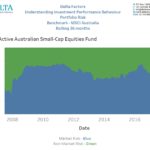
I’m skeptical of every fund so I conducted some in-depth performance analysis to understand K2′s performance drivers and most of the results certainly supported that they are a manager of skill. For example, since the end of 1999, K2 have outperformed the Australian sharemarket indices and achieved alpha of almost 5%pa whilst their market beta was a relatively low 0.66 (i.e. less risk than the market). It did have a small cap bias but my model showed that the market and small cap effect only explained around half of their performance with rest explained by other effects such as market timing…either way, great results for K2 since 1999.

Their relative performance since the end of the bull market (Oct 2007)  is excellent and this was totally explained by having low exposure to the market…beta less than 1 again plus very high alpha around 4%pa.

Where K2′s performance fell down was during the bull market from March 2003 to October 2007. Overall, they significantly underperformed the MSCI Australian Index by around 4,5%pa, but I guess it is difficult to complain when you receive 20%pa instead of the market’s 25%pa. My performance analysis showed that during this bull market K2 did not have the market exposure Lonsec claimed they would have (i.e. a beta close to 1) with a relatively low market beta of ~0.55 plus a reasonable exposure to small cap stocks. This low beta explains why they underperformed the market because during this time, K2 still were able to display skill with a strong alpha of 1% (after taking into small cap effects).

Anyway, in theory a variable beta fund could be a worthy addition to an investment portfolio if you are looking to outsource management of market exposure. I agree with Lonsec that K2 is an excellent fund for doing this job. The warning derived from my analysis is that, whilst variable beta funds (or a research houses) may tell you they will be fully exposed to sharemarkets during a bull market run, there’s always a chance they won’t hence they could significantly underperform the market during these times.


PDF Printer    Send article as PDF   

Buy-hold strategy may have had its day…I don’t think so

January 14, 2012 1 comment

Page 31 of the Australian Financial Review (AFR) today has an article suggesting “that the traditional buy-hold approach to owning shares is dead”…full text, with subscription can be found here. The article’s stated reason for buy-hold is that “in the long run, markets always go up and will provide investors with a good return on their investment as well as tax benefits, despite any volatility”.

Unfortunately, financial planners are placed in a dim light as usual, with ignorant comments like, “The buy-hold strategy is often sold by financial planners because it requires less management work – helpful for those with a large client base – as stocks selected are held for many years”.

Whilst there is a little bit if truth in each of the above statements, unfortunately the main reason behind the buy-hold strategy is ignored altogether. That is, that timing markets is very very hard and after transaction costs and potentially other costs are taken into account, there is more evidence to suggest that buy-hold is a far more successful method of achieving sharemarket returns than active management. This belief has the foundation in numerous academic articles, most notably Brinson, Beebower and Hood’s “Determinant of Portfolio Performance”, and the consistent failure of active managers to outperform benchmarks (see recent SPIVA results).

Unfortunately the AFR article suggests that in order to be successful at beating the buy-hold approach,  signals such as momentum, timing markets (good luck!) and the ability to pick ‘high-quality’ companies using certain factors is all you have to do. If only it was that easy.

For the individual investor, picking stocks is largely a mug’s game…sure you might beat the market but I can pretty much garantee it will typically be more through good luck than any demonstration of skill and any outperformance will probably come from taking on more roisk (even unknowingly).

Personally, I like the idea of being dynamic with regards to investment portfolio. My approach is a little different and is based around designing portfolios to accept or not accept various macro risks…the likelihood of underperformane must be accepted and outperformance will never be guaranteed like some of these fund managers market but rarely live up to.

Bottom line…there is no silver bullet but the most efficient way to receive sharemarket returns will be via a very cheap index fund…and that is a buy-hold strategy and a very popular strategy of financial planners and for good reason.


PDF Creator    Send article as PDF   

The change in outlook for the 2011 Australian Economy in one picture

January 10, 2012 Leave a comment

Source: RBA

The above chart shows pretty much what happened to the outlook for the Austrlaian economy and why bonds were the best investment for the year.

It shows the longer terms yields (3 years and above) dropping by up to 200bps thus providing very large capital gains for bond investors who had the courage of buying long term bonds at the start of the year. This yield curve movement also indicated the declining outlook for the Australian economy thanks largely to the Euro crisis and its potential impact on the banking system across the world.

For the short term bond holders (terms of 1 to 3 years), yields dropped by up to 150bps still providing strong capital growth. Whilst the yield to maturity dropped enormously across all maturies for Australian Government bonds, the Reserve Bank took a while to start the decrease and then only decreased by 50bps by the end of December. This curve still suggests the RBA has a few rate decreases to come and the Euro crisis will probably be the main determinant of that. That is despite the weak retail sales and weak residential property sales that provide increasing evidence of our weaker than you know economy. The Reserve Bank are also forecasting lower commodity prices which doesn help our resources sector so the outlook for growth across our economy may be moving closer to a one speed economy than we think.

Anyway, the year 2011 was certainly a year where the conservative bond investor was a winner and whilst I haven’t seen the final numbers yet, it looks like the gross returns should be a comfortably in double digits.

Create PDF    Send article as PDF   

Investment Thoughts for 2012

January 4, 2012 Leave a comment

Firstly I think its appropriate to suggest that I intend to make no return predictions for this year as I do believe its pretty much impossible with litte upside for me. However, what I would like to do is simply point out a few facts, rules, and current issues that need to be considered when building or reviewing the investment portfolio.

  • The big issue this year will once again be the Euro-sovereign crisis. This shold result in significant volatility for equity markets from time to time and daily movements exceeding 2% up or down will be relatively frequent. This type of volatility is the current norm for markets but whether those markets move up or down through to the end of 2012 is anyone’s guess.
  • Now whilst equity markets appear historically cheap on a PE basis, this is not necessarily a buy signal as PE ratios should be low in the face of high risk and lower than usual earnings growth, so be very very careful. Despite this warning, cash and bonds are hardly attractive on their own simple value metric, yield to maturity.
  • If you think you can pick stocks better than the professionals, I’m afraid you cannot. Even the professionals, backed by massive amounts of resources and always very very intelligent people, frequently fail to beat the market so if you are looking to accept any equity-like risk make sure you are very well diversified and use an index manager or an active manager who is not taking on too many risky bets (remember, noone really knows at this point in time how this European situation will ultimately impact markets)…just because your only stock Telstra outperformed the market this year does not mean you are a good investor…it actually suggests the opposite
  • The only free lunch in investing is diversification…this means don’t just invest in Australian equities (or Telstra), spread your investments across other investments such as Global equities, local and foreign fixed interest, local and global property, commodoties and if possible other alternative investments…but make sure the risk you accept is within your comfort zone
  • The sharemarket performance  of specific countries has very little to do with those countries economic growth. Two of the worst sharemarket performers this year were China, yes China, and India!!! Sharemarkets go up if information is more positive than expected and vice versa…this has nothing to do with economic growth…its expectations so if you can predict the future you’re looking good if you can’t, you’re possibly in trouble (unless you diversify)
  • If you are retired and want your money to last for the rest of your life…you can do this by either buying an annuity (lifetime or term certain which very long) or invest in a diversified portfolio of share, property, bonds, cash and don’t draw out too much each year (for example 5% or more linked to inflation). The financial services industry has talked many retirees into investing a very high proportion of their investment portfolio into shares (e.g. greater than 50%) and sold the concept of “over time the sharemarket outperforms”…whilst this is often the case in savings mode, it unfortunately doesn’t apply in drawdown (or pension) phase…you’ run a very big chance of running out of money before you know it!!!
  • You cannot get 10%pa return on your money without taking on a lot of investment risk. Cash and Bond interest rates paid by the Australian government are at most 4.25% (and that’s the cash rate)…so if you need to earn more than 4.25% you must take on more investment risk than the Australian government…so that will mean shares if you need to earn a lot more than 4.25% or may mean bank term deposits of you only need a little more than 4.25%.
  • Australian houses have dropped in price over the past 12 months…this is not an argument to suggest they are cheap. Interest rates may be reasonable but compared to our average household income we still have the most expensive housing in the world ( and don’t listen to what the banks say…they’re behind on their home loan budgets and need new business)
  • The best investment for anyone’s money will always be to pay off your non-tax deductible debt…so that includes your home loan, personal loan, and perhaps that loan that was taken out to contribute to superannuation (I know quite a few people did this in 2007 and they need to pay out those loans asap…but I’m sure they know that already). Non-deductible debt is a risk-free high return that compares to no other investment…if you don’t have non-deductible debt, fantastic and half your luck … and I’m happy for you to pay off my home loan!

I’m sure there’s many other little tidbits but I’m sure that’s more than enough to read for now and if I think of anything I’ll obviously let you know!

Create PDF    Send article as PDF   

A few too many ‘China Hard Landing’ stories for my comfort

December 19, 2011 Leave a comment

I’ve read a few too many times how Australia is well positioned because of its exporting links to China and how this should help us escape any serious economic issues flowing out of Europe. Obviously our markets haven’t quite agreed with that with bond yields dropping massively over recent months and our equity market continuing to show high volatility and dropping arond 20% since recording 2011 highs around 5000 back in April.

Overnight we have just had three articles from prominent economists indicating concerns about China …

Of course, a seriously troubling Euro crisis will spill over everywhere including China. Our economy is nowhere near as secure as many commentators or fund managers indicate and I have to admit to being the most bearish on our economy for quite some time…my perceived complacency and frustration with government and opposition focusing on budget surpluses is driving me nuts.

For investors, finding good investment return potential is very difficult indeed and takes some courage. Equity markets still carry plenty of downside risk let alone the usual day to day volatility, bonds have yields in the 3%s, and with an economy looking to slow more than we hoped, property looks scary, and even commodities are bound to drop signficantly in the face of a slower China.

I’m sure the focus of investors will continue to be capital protection over capital apreciation for some time yet. So I can only imagine that cash and term deposits will continue to be the investment of choice…particularly whilst term deposits continue to pay 1.5% to 2% over government debt. Personally, I believe if you can handle the volatility and hang in there for a while I tend to think corporate debt, which on average is paying a significant premium above governemnt debt, should provide the best return potential…only record default levels should stop a decent return on corporate debt (not that its out of the realm of possibility) in the next few years so ensure the portfolio is well diversified and be prepared for a bumpy ride.

Create PDF    Send article as PDF   

Term Deposit Premium very high again

October 29, 2011 Leave a comment

Source: Reserve Bank of Australia

The above chart shows the premium banks are paying for their 3 year term deposits compared to 3 year Australian Government bonds from 1992 to the end of September 2011. Since hitting its aboslute high around the start of 2010 and peaking again around July 2010, term deposits are paying aound 2% more than government bonds once again (although I acknowledge the data is a few weeks old). With the Australian government still providing a guarantee on bank deposits up to values of $200,000 from February 2012 onwards (its currently $1m), term deposits are certainly looking quite attractive for the retail investor.

Unfortunately bond funds can’t quite take advantage of these good rates. This is because banks, building societies, and credit unions aren’t interested in accepting massive sums from institutional investors knowing there is a high probability that at maturity the institutional investor won’t reinvest. This is a risk to the financial institution’s balance sheet which they look to reduce and do so by limiting the level of institutional investment and paying lower rates compared to retail investors. Retail investor money is wonderfully sticky compared to a large institution.

PDF    Send article as PDF   

Australian Equities Fund Manager Style over time

October 29, 2011 Leave a comment

A couple of weeks ago I did a post showing Fama French 3 Factor analysis on some of the leading Australian Equities fund managers. The analysis covered returns from June 2003 to September 2011 so it obviously covered a mixture of markets…bull bear and sideways. I just completed the same analysis but this time I divided the data into three distinct markets…

  1. Bull Market from 2003 to the end of October 2007
  2. Global Financial Crisis bear market from the end of October 2007 to its bottom at the end of February 2009
  3. The GFC recovery since the end of February 2009 to September 2011

The updated results are…


Data Source: van Eyk, Morningstar

My factor descriptions are…

  • Annualised Alpha is effectively the skill the manager brings after all factors are considered…e.g. it includes their market timing skills
  • Market Beta – represents the fund’s volatility relative to the market’s. So a Market Beta of 1 means the fund’s performance moves in sync with the market’s
  • HML – this factor is long MSCI Australia Growth and short MSCI Australia Value…so if the results are positive then chances are the fund is a “Growth” fund and “Value” is negative
  • SMB – this factor is Long Small Caps and Short the ASX200…therefore a positive result shows a small cap bias relative to the market

I haven’t produced the statistical significance of each factor but I have highlighted the significant results for the HML factor. These results indicate some consistency of style across at least 2 of the 3 markets from DFA Australian Value and Investor’s Mutual (IML) which are both value biased; BT, Fidelity, and Ausbil which are each growth biased; and Tyndall, Perpetual, and DFA Large Cap which don’t appear to be either value or growth biased although Tyndall has a growth bias in the bull market preceding the GFC.

I’m not so sure Perpetual and Tyndall will agree with me on that given they both state they are value managers but the results are the results. Both of these managers also appear to have a greater small cap bias than all others (except DFA Aust Value) so I guess that is where their focus has been. Whilst they may claim to be “value” managers they appear to be a little more focused in small cap land than their competitors…something to keep in mind when considering their portfolio inclusion.

Unsurprisingly all managers shows high market betas, which is a typical characteristic of well diversified long only managers so when the market goes down (or up) so too do these funds.

In terms of what combinations may be best…its looking like Fidelity combined with either IML or DFA Aust Value.

PDF Download    Send article as PDF   

SPIVA Results – Active Managers still struggling

October 17, 2011 1 comment

I’m quite late in reporting the recent performance of fund managers from my favourite performance report, Standard and Poor’s SPIVA. For those that don’t know the reason why this is my favourite report on fund manager performance is that it considers survivorship. It does this by examining all fund managers at the start of the reporting period, as opposed to the Mercer, Morningstar, and other performance surveys who look at performance of the fund managers who are still around at the end of the reporting period, which excludes managers who have blown up, experienced high levels of redemptions, or failed to attract sufficient funds and closed.

Anyway, the table above shows the proportion of fund managers who have failed to outperform standard benchmarks of their respective asset class.

Over the 12 months to 30 June 2011, once again only small cap Australian equity managers have more than 50% of managers outperforming their index.

The most interesting result is that more than 50% of both Australian Equity General and A-REIT managers have outperformed over the last 3 years. Unfortunately for them the 5 year results are quite dismal with more than 70% and 60% respectively underperforming their respective index.

As expected, Australian bond managers have the most trouble outperforming the UBS Composite index and despite the yield curve changing shape numerous time  the past 5 years and the same with credit spreads, active managers have consistently struggled.

Create PDF    Send article as PDF   

Sensational Bearish Interview

September 26, 2011 Leave a comment

Found this via Zero Hedge …sensational interview on the BBC with a trader who believes “Goldman Sachs rules the world” and that “this economic crisis is like a cancer, if you just wait and wait thinking this  is going  to go away, just like a cancer its going to grow and its gong to be too late”…the BBC interviewers were flabbergasted

Create PDF    Send article as PDF   

Hedge Funds and Banks straining

September 15, 2011 Leave a comment

Last night UBS lost $2billion due to another “rogue” doing unauthorised trades and as reported last night by Zero Hedge, Goldman Sachs are shutting down their famed (or perhaps infamous), Global Alpha hedge fund. The obvious question posed by Zero Hedge is whose next? and I wonder which Australian fund(s), if any, will be hit.

Since the GFC when numerous Australian funds (mortgage, credit, hedge funds, and illiquid property funds) froze to redemptions, these funds have struggled as investors have sought increased transparency and lower cost investments (index funds, term deposits, and annuities). Because Australian investors haven’t jumped backed into these potentially illiquid and high risk funds I don’t there’s too much likelihood of another round of fund problems here. There may be the occasional hedge fund blow up (in fact I heard anecdotally about a start-up options trading hedge fund that blew up last month just a matter of months after starting), but given the relatively conservative appetite in Australia I think all should be ok (although Europe and US economies are still in deep doo-doo as is the Euro-sovereign and Euro currency situation)…I’ll let you know if I change my mind!

PDF    Send article as PDF   
Follow

Get every new post on this blog delivered to your Inbox.

Join other followers:

Switch to our mobile site